1. A Living Fossil
The Nautilus is considered a living fossil. These cephalopods have remained remarkably unchanged in appearance and basic anatomy for over 500 million years, predating dinosaurs and surviving multiple mass extinction events. Their persistence offers invaluable insights into ancient marine ecosystems and evolutionary lineages, making them a crucial subject for paleontological and biological research.
2. The Chambered Shell
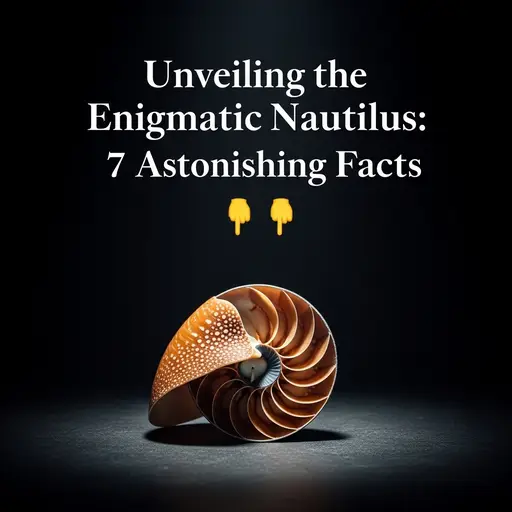
The iconic Nautilus shell is not a single compartment but a series of chambers. As the Nautilus grows, it builds new, larger chambers and seals off older ones. It then moves into the newest, largest chamber, leaving the previous ones behind. These sealed chambers are filled with gas or liquid, which the Nautilus can regulate to control its buoyancy in the water column.
3. Buoyancy Control
Nautilus buoyancy is meticulously managed by shifting the ratio of gas and liquid within its shell chambers. By pumping water out and allowing gas to fill the empty space, the Nautilus can ascend, and by reversing the process, it can descend. This sophisticated internal hydro-static system allows for precise depth control without expending significant energy.
4. Deep-Sea Dwellers
These cephalopods inhabit the deep waters of the Indo-Pacific region, typically found between 200 and 600 meters (650 to 2,000 feet). Their habitat is characterized by low temperatures, high pressure, and limited light. Adapting to these challenging conditions has shaped their unique physiology and survival behaviors, making them a subject of interest for deep-sea exploration.
5. Carnivorous Predators
Nautiluses are opportunistic carnivores. Their diet primarily consists of small fish, crustaceans, and other marine invertebrates. They use their numerous tentacles, which can extend up to 70, to capture prey. Their powerful beak, hidden within the tentacles, is used to tear food apart before ingestion.
6. Slow and Steady Reproduction
Compared to other cephalopods like squid and octopus, Nautiluses have a remarkably slow reproductive cycle. Females lay a relatively small number of eggs, often in clusters attached to rocks or coral. The eggs take a significant amount of time to hatch, and the young Nautiluses are fully independent upon emergence, possessing a miniature version of the adult shell.
7. Vulnerable to Overfishing
Despite their ancient lineage, Nautilus populations are facing threats, primarily from overfishing. Their shells are highly valued for their aesthetic appeal, leading to their capture for the curio trade and jewelry. Conservation efforts are crucial to protect these ancient mariners from extinction.