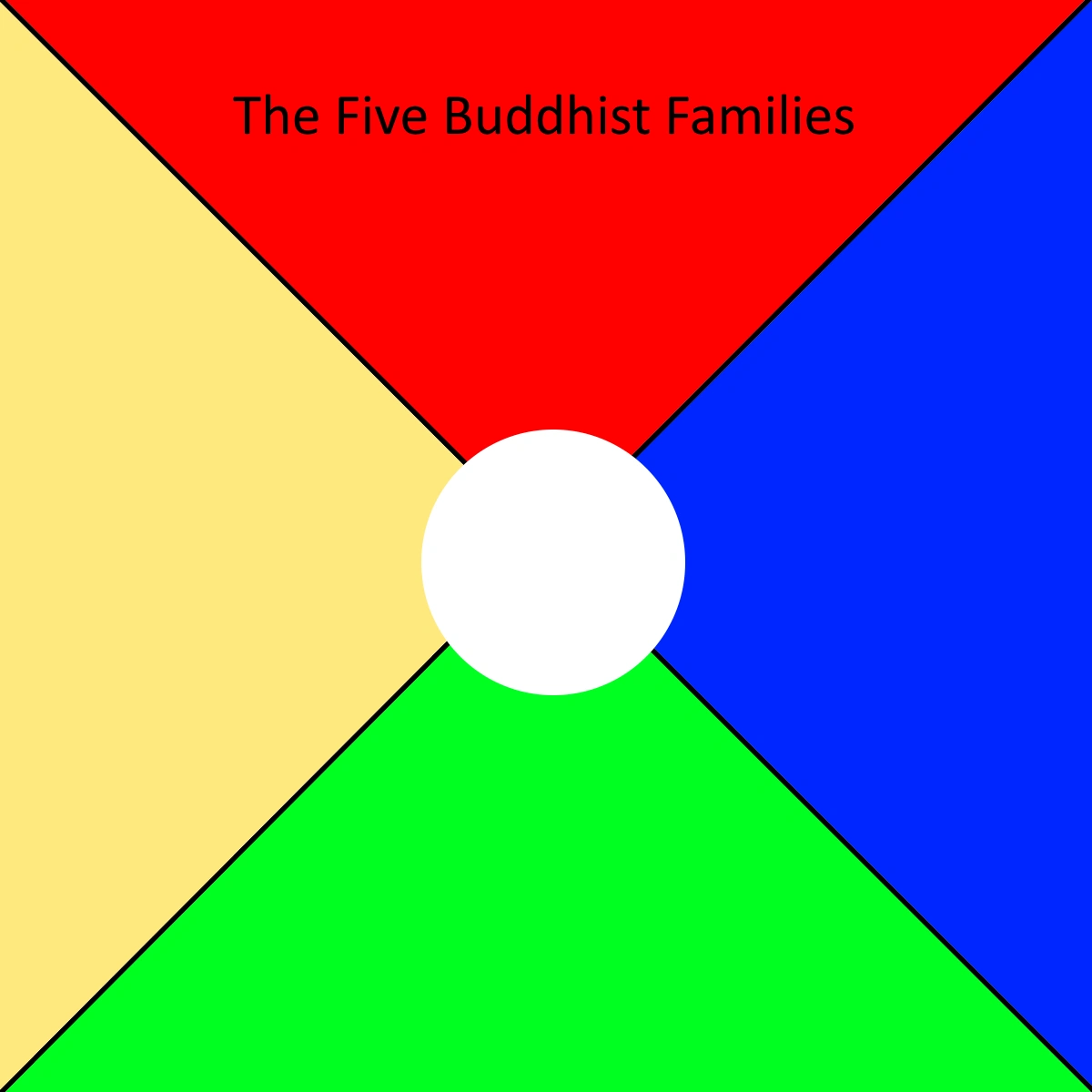
01. The buddha family. (Skt. tathāgatakula). The tathagata family.
The first Buddhist family is the Buddha family, it is represented by the color white, and is represented by the element of eternal space.
The symbol of the Buddha family is the eight-spoked wheel of dharma representing authentic teachings of the Buddha, it is an object that turns and by turning the turn of it, it makes it possible for us to comfortably reach a certain destination.
The wheel of the authentic teachings has eight spokes as a sign that it is possible to reach the ultimate destination of Buddhahood by means of the eight-fold path of the noble ones. Moreover, by means of the eight-fold path of the noble ones it is possible to attain the wisdom of suchness, and the primordial awareness of the dharmadhatu (having a purified mind).
This family reminds us to bond closely with mirror-like awareness, to take safe direction (refuge) in the Three Jewels and the three types of ethical self-discipline, and to help all sentient beings.
02. The vajra family. (Skt. vajrakula).
The Vajra family is represented as blue, and its element is water.
The figures represented in this family represent the patience and the wisdom of mirror like awareness.
The symbol of the Vajra family is the diamond-like or adamantine thunderbolt called a vajra. A vajra is the symbol for unchangeability and represents the endowment of a clear and stable way of appearing.
The Vajra family reminds us to bond closely with sphere of reality awareness, and in the vajra, the clarity of appearing in pure appearances and the blissful awareness that it represents and in the bell, the awareness of voidness it represents as wisdom, in maintaining the mudra (seal) of visualizing ourselves as Buddha-figure couples in union, representing the inseparable union of nondual method and wisdom, and finally to committing ourselves properly to healthy relationships our teachers and others.
When represented in a mandala it is positioned in the East which in East Asia is represented by the pure land of Abhirati.
03. The ratna family. (Skt. ratnakula). The gem family.
The Ratna family or precious ones are represented by the color yellow and the element of the earth.
The related figure representations represent the wisdom of the awareness of sameness or equality and equanimity and represent the enlightened activity of increase, multiplication, the extension of life, merit, wealth, happiness, and joy.
The symbol of the Ratna family is a jewel.
The Rata family reminds us to bond closely with equality awareness, and the four types of generosity.
When represented in a mandala it is positioned in the South which in East Asia is represented by the pure land of Śrīmat.
04. The padma family.(Skt. padmakula). The lotus family.
The Padma family is represented as red and its element is fire.
The related figures represent the wisdom of discriminating awareness and compassion.
The symbol of the Padma family is the lotus.
When desirous attachment is perfectly purified, it resembles an utterly beautiful and attractive flower with bright colors and a perfect shape. A real flower of such beauty, however, is not an actual object for attachment and grasping because it is impermanent and its beauty ephemeral.
The padma family reminds us to bond closely with individuality awareness and the upholding of the teachings of the sutra vehicles (shravaka, pratyekabuddha, and bodhisattva), of the outer classes of tantra (kriya and charya), and of the confidential (secret) classes of tantra (yoga and anuttarayoga).
It represents the transformation into enlightenment by means of the attainment of the perfection of wisdom.
When represented in a mandala it is positioned in the West which in East Asia is represented by the pure land of Sukhāvatī.
05. The karma family. (Skt. karmakula). The action family.
The Karma family is represented as green and its element is the air/wind.
The family represents joy and the wisdom of all accomplishing activities, and that when we give ourselves fully to the benefit of our world, things eventually work as they need to.
The symbol of the Karma family is the sword or a double vajra. The vajra symbolizes un-changeability, where there is no change there is no way anything can progress to a more superior state of being. Something that is unchangeable cannot degenerate and turn towards faults, nor can it increase positive qualities.
The Karma family reminds us to bond closely with all accomplishing awareness, coming back to our practice and keeping our promises. Never give up doing the right thing.
When represented in a mandala it is positioned to the North which in East Asia is represented by the pure land of Karmaprasiddhi or Prakuṭā.