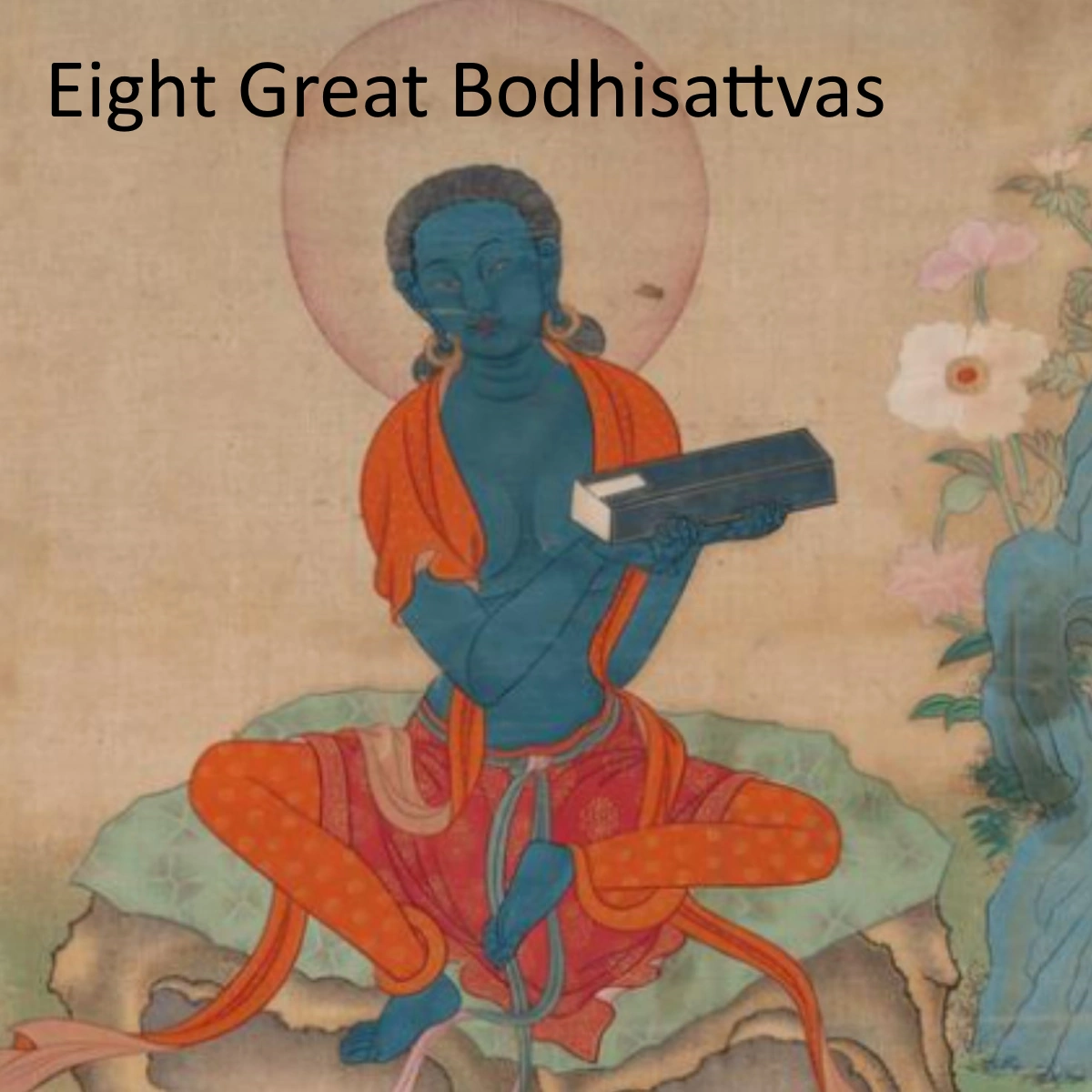
01. Kshitigarbha or Kṣitigarbha. One of the Four Inner Offering Bodhisattvas.
Kshitigarbha or red lotus is from the vajra family and embodies the richness and fertility of the land and the the natural purity of visual or eye consciousness.
He may exhibit the earth touching (Bhumisparsha) mudra (Hand gesture),
Kshitigarbha is often white in color (sometimes yellow), often seen on the right side of Vajrasattva.
Holding a seedling or Kalpa tree, and a bell, Kshitigarbha is associated with the south and has a wrathful deity of Aparājita.
Lasya is the consort of Kshitigarbha.
Kṣitigarbha is often depicted as a Buddhist monk, the king of the great vow, is known for his vow to take responsibility for the instruction of all beings in the six worlds between the death of Gautama Buddha and the rise of Maitreya, as well as his vow not to achieve Buddhahood until all hells are emptied.
In the Chinese Mahayana tradition, he is known as Di Zang Wang Pu Sa (地藏王菩薩), Earth-Store bodhisattva or Earth Treasure Bodhisattva, in Japan, he is known as Jizo, relied upon by those who have lost their children, born or unborn, his name in Tibetan, Sa yi nying po (ས་ཡི་སྙིང་པོ) which translates as “Essence of Earth.”
Om, pun-lah-moh lin-toh-lin, so-ha. (Sanskrit: Om, prama nidani svaha.)
Om, ha ha ha, wei sam-mo-deh, so-ha. (Sanskrit: Om, ha ha ha vismaye svaha.)
02. Akashagarbha, Ākāśagarbha, Kokūzō Bosatsu, Khagarbha, Nam kai nying po or Gaganagañja. One of the Four Inner Offering Bodhisattvas.
Akashagarbha, the master of the great element of empty space, sometimes known as sky jewel, is from the Ratna family, represents the purifying of transgression and symbolizes the purity of smell or nose consciousness, he is said to have unlimited wisdom.
Akashagarbha where represented is golden yellow in color, is often seen to the right of Ratnasambhava and holds a sword and a bell, sometimes he will exhibit a Varadamudra (hand gesture with palm held outward) with a Cintāmaṇi (or wish fulfilling jewel).
Akashagarbha is associated with the north west and has a wrathful deity of Kuṇḍali.
Malya is the consort of Akashagarbha.
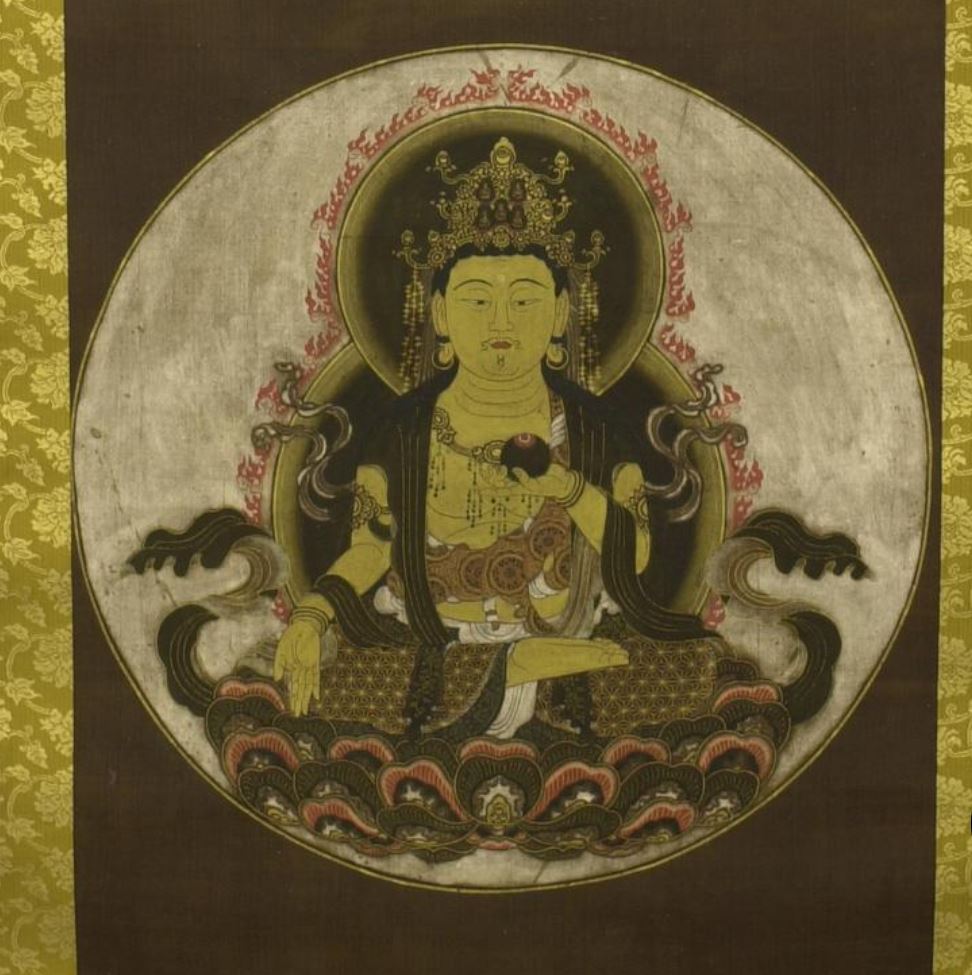
03. Avalokiteshvara, Avalokiteśvara, Avalokitshvara, Lokesvara, Chenresi or Guanyin. One of the Four Inner Offering Bodhisattvas.
Avalokeshvara is the self master of vision, the listener of the world's cries who uses skilful means to come to their aid, he has the power to see the suffering of sentient beings in all realms and to provide effective assistance to alleviate their suffering, hi name means the lord who looks down with compassion. Avalokiteśvara is perhaps the most venerated Buddhist deity as he at the same time also represents the embodiment of the bodhisattva's compassion and the purity of tactile consciousness, a great treasure of non aimed affection, and tongue or taste consciousness.
Avalokeshvara is one who refused to accept Nirvana since he considers such acceptance selfish in view of the ignorance of the great majority of the people who have not yet attained that stage. His sacrifice symbolizes infinite compassion (Karuna), sharing of mankind’s misery, willingness to help those in distress.
Avalokeshvara holds in his hand the indestructible jewel, and sometimes a lotus and a bell, he is often colored red, sometimes white, and can have a thousand arms and elven heads. He is saviour and protector from danger. So, his invocation (Mantra) “OM MANI PADME HUM” is found inscribed on rocks, loose stones, prayer wheels, etc.
He is often seen to the right of and descends from Amitabha with a samadhi mudra.
Avalokiteshvara is associated with the west and is represented as or with the wrathful deity of Hayagrīva.
Narti is the consort of Avalokiteshvara.
Songtsen Gampo, who was instrumental in introducing Buddhism to Tibet, was identified as an incarnation of the bodhisattva Avalokiteshvara.
Other forms Avalokiteshvara exist such as Shadakshari Lokeshvara and Mahakaruna.
Om, ma-nee pad-mee, hum. (Sanskrit: Om, mani padme hum.)
04. Vajrapani, Vajrapāṇi. One of the Four Inner Offering Bodhisattvas.
Vajrapani, keeper of the secret treasures of all Tathagatas, or lord of the secrets, embodies power and the purity of the defiled consciousness, a destroyer of all hordes of demonic forces.
Vajrapāṇi is one of the earliest-appearing bodhisattvas in Mahayana Buddhism and he is the protector and guide of Gautama Buddha who rose to symbolize the power of the Buddha.
Vajrapani literally means carrying Vajra in hand. The expression of Vajrapani is wrathful, symbolized as a yaksha, to generate fear in individual to loosen up his dogmatism. His outstretched right-hand brandishes a vajra symbolizing analytical knowledge that disintegrates the grasping of consciousness, along with a bell. He sometimes wears a skull crown, but in most depictions, he wears a five-pointed bodhisattva crown to depict the power of the five Dhyani Buddhas. Vajrapani is seen as a spiritual reflex of Bodhisattva Akshobhya. On the popular level, he is the bodhisattva who represents the power of all the buddhas just as Avalokiteśvara represents their great compassion, and Mañjuśhrī represents wisdom. He is called the Master of Unfathomable Mysteries who upholds truth even in adversities of darkness and ignorance.
He is often emerald Green in color, sometimes yellow and is positioned to the left of Amogasiddhi, and manifests the purity of ear consciousness.
Vajrapani is associated with the south east and has a wrathful deity or avatar of Trailokyavijaya.
Gita is the consort of Vajrapani and Garuda and Mahasthamaprapta are forms of Vajrapani.
A similar Ratnapani exists, meaning gem in hand.
The mantra oṃ vajrapāṇi hūṃ phaṭ is associated with Vajrapāni and his Seed Syllable is hūṃ.
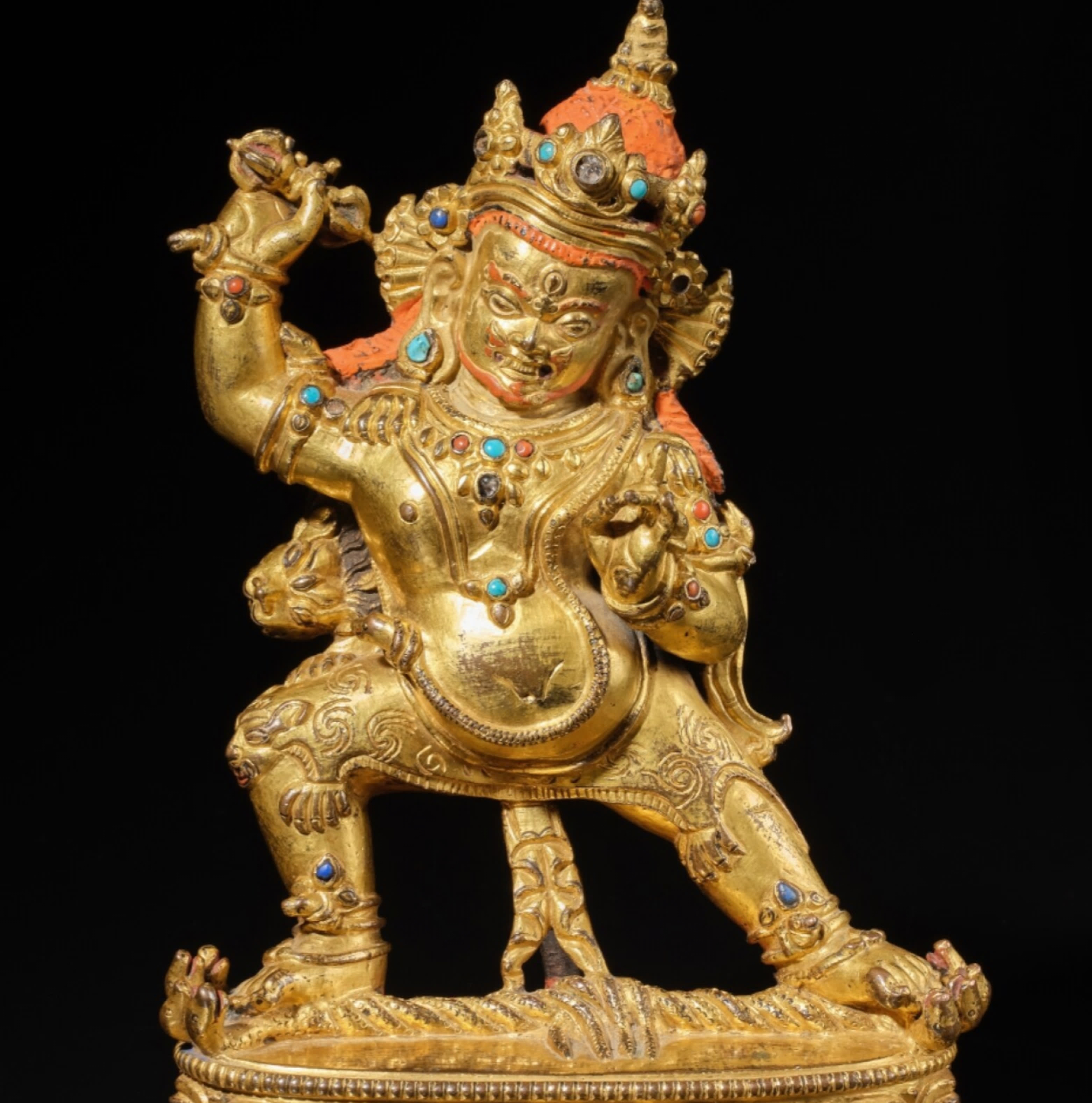
05. Maitreya or Ajita. One of the Four Outer Offering Bodhisattvas.
Maitreya, the future buddha, is from the vajra, family, associated with Amoghasiddhi, and embodies love and the natural purity of auditory consciousness, or the eyes and can sometimes be seen with the dharmachakra mudra, the gesture of religious discourse.
Maitreya is sometimes depicted as whitish-yellow in colour and holding an orange bush which dispels the fever of the destructive emotions and a bell.
Often seen to the left of Vajrasattva.
Maitreya is associated with the south west and has a wrathful deity of Mahācakra.
Dhupa is the consort of Maitreya.
He is said to currently reside in Tuṣita heaven, as Śākyamuni’s regent, where he awaits the proper time to take his final rebirth and become the fifth buddha or a Brahman in the Fortunate Eon, reestablishing the Dharma in this world after the teachings of the current buddha have disappeared.
06. Samantabhadra or Kuntuzangpo. One of the Four Outer Offering Bodhisattvas.
Samantabhadra, the primordial Buddha, is called the the sword and assists with prayers of aspiration, he is yellow in color and if often see to the right of Ratnasambhava.
Samantabhadra holds a grain sheath and a bell, and symbolizes the natural purity of olfactory consciousness or nose/smell.
Samantabhadra is associated with the North and has a wrathful deity of Padanakṣipa.
Aloka is sometimes the consort of Samantabhadra.
Together with the Buddha and Mañjuśrī, he forms the Shakyamuni trinity in Buddhism (Shakyamuni trinity being the three Buddha which depicts the strength and wholeness that comes from joining wisdom with skilful means). He is the patron of the Lotus Sutra and, according to the Avatamsaka Sutra, made the ten great vows which are the basis of a bodhisattva.
Samantabhadrī in Tibet is the consort and female counterpart of Samantabhadra, known as the primordial Mother Buddha, mother of all Buddha, she is also is also considered an analogue of Prajaparamita.
They are usually shown in sexual union (yab/yum in Tibetan), the blue male figure and white female figure embracing each other in lotus position.
Vajradhatuishvari is almost equivalent to Samantabhadrī.
Mañjushri embodies prajñā, wisdom and insight and is from the Padma family where Akshobhya is the head, he is the purity of mental consciousness or tongue/taste, a commander of flawless wisdom.
He holds a sword, and sometimes a bell, sometimes a manuscript (the prajñāpāramitāsūtra) atop a lotus, and is orange red, golden or yellowish skinned in colour and sits in the midst of a blazing mass of flames.
Supreme wisdom, pervading everywhere, is perfectly represented by/as Mañjushri and he is therefore the dispeller of ignorance and the disseminator of knowledge.
Bodhisattva Manjusri and Maitreya are the often depicted with the Gautama Buddha with Manjusri on the left and Maitreya on his right, representing wisdom and teaching receptively and is often seen also to the left of Amitabha.
He helps us to confront and deal with the negative emotions such as anger, depression, fear and denial that arise when we are challenged by serious health problems or when we are confronted with problems in our daily life.
Mañjushri is associated with east for example, the Lotus Sutra assigns him a pure land called Vimala, which according to the Avatamsaka Sutra is located in the East
Mañjushri has a wrathful deity of Yamantaka the terminator of death, and a consort Saraswati, there is also Manjuvajra, an esoteric form of Manjushri, described in the Nishpanna Yogavali (Garland of Perfection Yoga) as providing a path to wisdom and intelligence, usually with three faces and six arms with two folded or holding his consort Sparsavajra (also known as Adhiprajna).
Vajradhatvishvari (Tib. rDo-rje dbyings-phyug-ma) as the Mistress of the vajra realm may also also become the golden consort of Manjuvajra.
The black Mañjushri (sometimes called Yamantaka) is depicted normally black or deep blue in colour, with black hair tied up in knot on the skulls crown, single face and two arms with three eyes, right hand holding a sword blazing with flames symbolic suppresses obstructing all demons, left hand holding up the paramita text.
He is associated with the “Wisdom mantra”: Om Ah Ra Pa Cha Na Dhi.
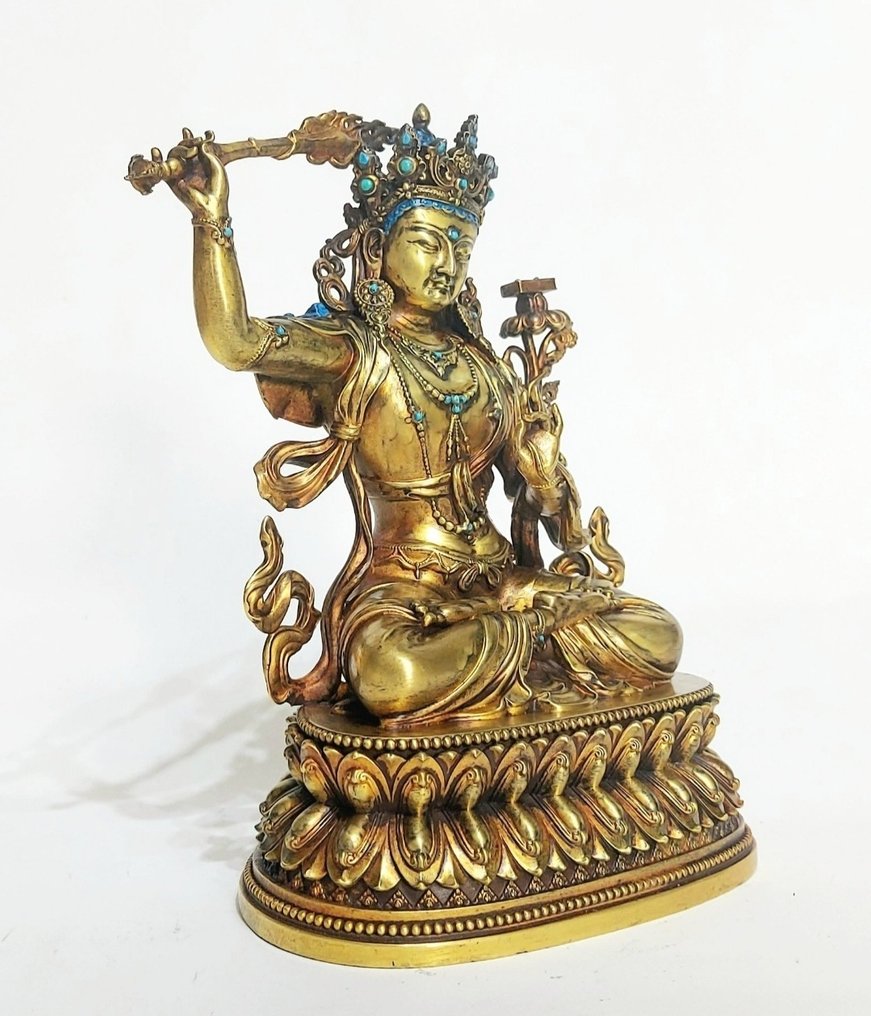
08. Sarvanivaranavishkambhin, Sarvanivāraṇaviṣkambhin, Viskambhi or Nivaranaviskambhin. One of the Four Outer Offering Bodhisattvas.
Sarvanivaranavishkambhin purifies wrong doing, and symbolizes the purity of grounded consciousness, the one who “One Who Completely Dispels All Obscurations (things that are hidden)” and represents the purity of the ears or hearing.
Sarvanivaranavishkambhin is green in color is is often seen to the right of Amogasiddhi, holding a book and a bell.
Sarvanivaranavishkambhin is associated with the north east and has a wrathful deity of Acala.
Puspa is the consort of Sarvanivaranavishkambhin.