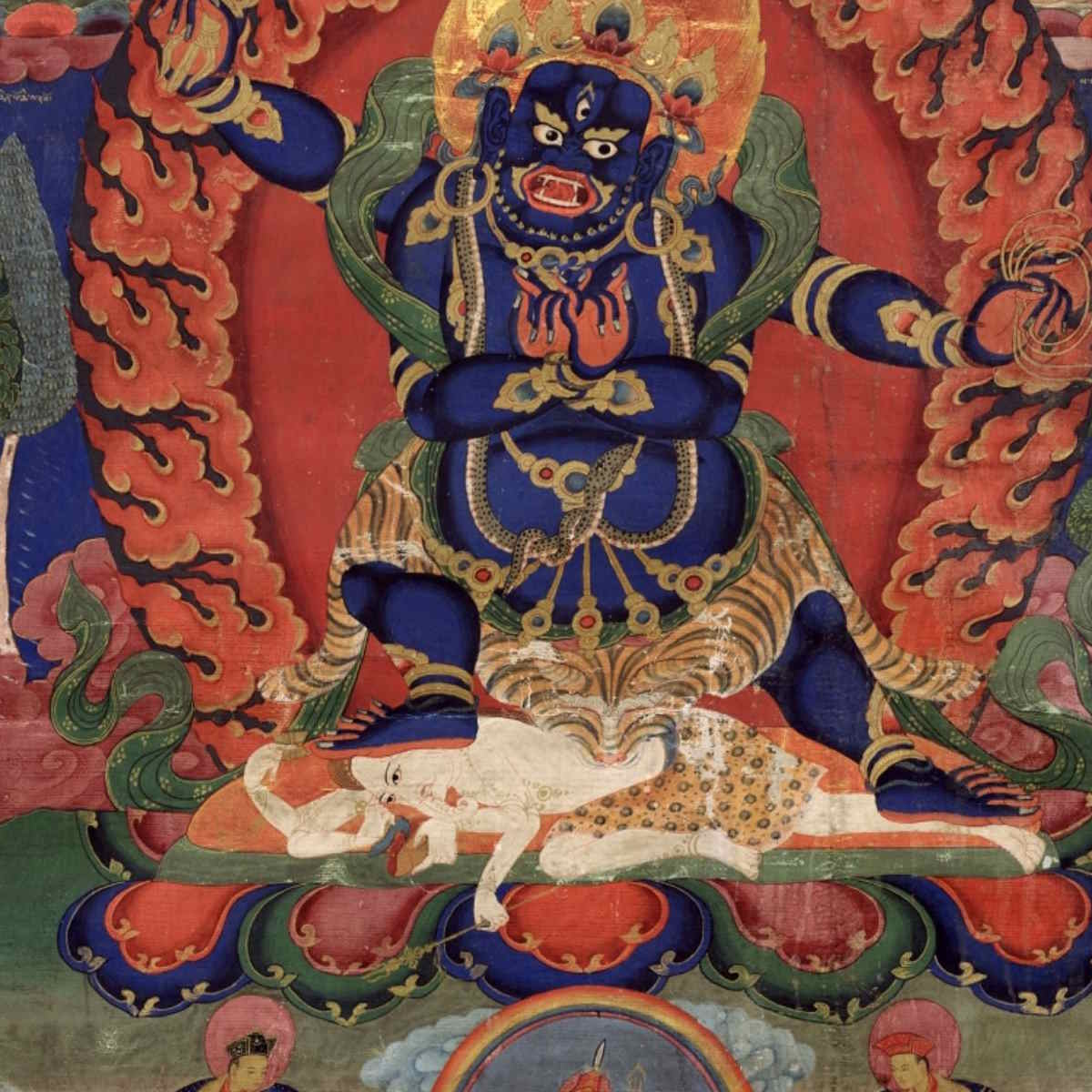
First circle, Mahesvara (E).
Northeast; Skt : Isana; said to live in the sixth, or highest, heaven of the world of desire; in right hand, often holds a three-pronged spear (trident), and in his left a bowl of blood (see painting at Kyoto National Museum); Ishana is an obscure dikpala (a god who guards one of the eight directions), whose name simply means "the Lord." Also one of the eight manifestations of Shiva.
Also known, in Japan, as Daijizaiten 大自在天, which is the translation of Sanskrit Mahesvara (also transliterated as Makeishura 摩醯首羅), one of the many names of Shiva (Siva), who, along with Brahma (Bonten 梵天) and Visnu is one of the three chief gods of Hinduism. Daijizaiten was adopted into Buddhism as a protector of the Buddhist teachings and became one of the "Twelve Deva". In this context he appears under the name Ishana 伊舎那. According to the traditions of Esoteric Buddhism, before becoming a Buddhist tutelary deity, Daijizaiten was first vanquished by Gouzanze Myou-ou 降三世明王, the conqueror of earthly desires. As a result he and his consort Uma 烏摩 (Skt: Uma) often appear in representations of Gouzanze, who is shown trampling them underfoot. Gigeiten 技芸天, a minor deity in Japan and patroness of the arts, is believed to have been born from Daijizaiten’s hairline.
First circle, Visnu (S).
Northeast; Skt : Isana; said to live in the sixth, or highest, heaven of the world of desire; in right hand, often holds a three-pronged spear (trident), and in his left a bowl of blood (see painting at Kyoto National Museum); Ishana is an obscure dikpala (a god who guards one of the eight directions), whose name simply means "the Lord." Also one of the eight manifestations of Shiva.
Also known, in Japan, as Daijizaiten 大自在天, which is the translation of Sanskrit Mahesvara (also transliterated as Makeishura 摩醯首羅), one of the many names of Shiva (Siva), who, along with Brahma (Bonten 梵天) and Visnu is one of the three chief gods of Hinduism. Daijizaiten was adopted into Buddhism as a protector of the Buddhist teachings and became one of the "Twelve Deva". In this context he appears under the name Ishana 伊舎那. According to the traditions of Esoteric Buddhism, before becoming a Buddhist tutelary deity, Daijizaiten was first vanquished by Gouzanze Myou-ou 降三世明王, the conqueror of earthly desires. As a result he and his consort Uma 烏摩 (Skt: Uma) often appear in representations of Gouzanze, who is shown trampling them underfoot. Gigeiten 技芸天, a minor deity in Japan and patroness of the arts, is believed to have been born from Daijizaiten’s hairline.
First circle, Brahma (W).
Heaven Deva; Skt. = Brahmā or Sikhin; guards the upward direction; Hindi deity who created the universe, with four heads for overlooking each of the four directions (although often shown with only one). Also known as the universal soul, in contrast to the individual soul (atman). Bonten’s “vahana” is the wild goose. Four infinite virtues are attached to Bonten: (1) give others happiness; (2) remove their suffering; (3) help them see, thus freeing them from desire; (4) help them abandon attachment to love and hate to become impartial to all. One can attain rebirth in the Brahma Heaven, it is said, by practising these virtues. Bonten lives in the first of four meditation heavens, in the world of form, above Mount Sumeru; said to rule the “saha” (Sanskrit word for endurance and for the world of suffering); people in the saha world endure many sufferings caused by desire and three poisons -- greed, anger and foolishness.
First circle, Karttikeya (N).
Lord Karttikeya is a well known figure in Hindu mythology. He addressed by different names such as Murugan, Subramaniam, Sanmukha, Skanda and Guha. He is most popular as Lord Murugan in the southern states of India. A number of temples dedicated to the deity can be spotted all over the South India.
First circle, Ganapati (NE, Īśāṇa, Siva corner).
Ganesha (Sanskrit: गणेश, IAST: Gaṇeśa), also spelled Ganesh, and also known as Ganapati, Vinayaka, and Pillaiyar, is one of the best-known and most worshipped deities in the Hindu pantheon.
First circle, Aditya (SE, Agni, Fire corner).
Sun Deva; Skt : Surya, Aditya
Great Heavenly Sun King, a Hindu god adopted into Buddhism as a protector; said to be a subject of Taishakuten.
Also see Yakushi Nyorai, who is often flanked by Nikko and Gakko.
Nikko = Suryaprabha
Gakko=Candraprabha
First circle, Rahu (SW, Nairṛta, Demon corner, नैरृत).
Rahu, considered a planetary deity who represents the eclipses of the sun and the moon, plays a number of roles in the myths, art, and religions of South and Southeast Asia.
First circle, Nandin (NW, Vayu, Wind corner).
Nandi (Sanskrit: नन्दि), also known as Nandin, Nandikeshvara or Nandideva, is the bull vahana (mount) of the Hindu god Shiva. He is also the guardian deity of Kailash, the abode of Shiva. Almost all Shiva temples display stone-images of a seated Nandi, generally facing the main shrine.
Second circle, Sri (E).
Lakshmi Sanskrit: लक्ष्मी, IAST: Lakṣmī, sometimes spelled Laxmi, lit. she who leads to goal also known as Shri (Sanskrit: श्री, IAST: Śrī, lit. 'Noble'), is one of the principal goddesses in Hinduism. She is the goddess of wealth, fortune, power, beauty, fertility and prosperity, and associated with Maya ("Illusion"). Along with Parvati and Saraswati, she forms the Tridevi of Hindu goddesses.
Second circle, Tiolottama (S).
Tilottama (Sanskrit: तिलोत्तमा, romanized: Tilottamā), is an apsara (celestial nymph) described in Hindu mythology.
"Tilasma" is the Sanskrit word for a small particle and "uttama" means the ultimate. Tilottama, therefore, means the being whose smallest particle is the finest or one who is composed of the finest and highest qualities.
Second circle, Sasi (W).
Second circle, Uma (N).
Second circle, Ratnasri (SE, Agni, Fire corner).
Ratnaśrī (रत्नश्री) is the name of a Bodhisattva, according to the Gaganagañjaparipṛcchā: the eighth chapter of the Mahāsaṃnipāta (a collection of Mahāyāna Buddhist Sūtras). Accordingly: “Then the Bodhisattva, Ratnaśrī by name, came and sat down in this assembly, said to the Bodhisattva Gaganagañja: ‘With reference to the teaching of concentration, son of good family, may you elucidate what kind of concentration should be purified. Thus addressed, the Bodhisattva Gaganagañja said this to the Bodhisattva Ratnaśrī. Then the Lord applauded the Bodhisattva Gaganagañja: Good man, the teaching of this gate to concentration was well spoken by you. Just as the dharmas are not dependent on others because they are directly perceived by [the senses] of your body, in the same way the knowledge of the Tathāgata was elucidated this complete teaching is good, very good”.
Second circle, Sarasvati (SW, Nairṛta, Demon corner, नैरृत).
Originated from the goddess of Music, the wife of Hindu god Brahma. She is famous as the goddess who bestows the fortune and treasure of the Seven lucky gods. In Japan, she is also known as Benten sama.
Second circle, Surasundari (NW, Vayu, Wind corner).
Surasundarī (सुरसुन्दरी) refers to a beautiful goddess according to the Cakrasaṃvara Samādhi ritual often performed in combination with the Cakrasaṃvara Samādhi, which refers to the primary pūjā and sādhanā practice of Newah Mahāyāna-Vajrayāna Buddhists in Nepal. Accordingly, “By the form of a skull cup, and by the letter Māṃ, Vāruṇī, Eighteen arms, one face, red color, and three eyes, A sword, arrow and hook, on the right, a skull cup, axe and banner, Thus a mace, thus a bell, and in the ninth, granting wishes, A two-headed drum, a bow and noose, a staff and a water pot, A trident, hammer and lute, and thus a number, in the upper hand, A young adolescent beauty, a great beauty, a beautiful goddess (surasundarī)”.
Second circle, Vibhuti (NE, Īśāṇa, Siva corner).
a) Vibhūti (विभूति).—A name of Śrī (Lakṣmī). Her abode in the chest of the Lord; wife of Hari.
1b) Of Hari; Indra among gods, Viṣṇu among Ādityas, Bhṛgu among Brahmaṛṣis and so on.
Third circle, Sakra (E).
East. Skt = Indra, Indira, or Sakradevanam. Indra is the Hindu god of war; Taishakuten is also represented at the center of the world when grouped with the Shitennō.
He governs the 32 other gods who live in Zenkenjo (Palace of Correct Views) in the Buddhist heaven (Trayastrimsha) on the peak of Mt. Sumeru
Third circle, Yama (S).
South; Hell Deva; Skt : Yama or Yama-raja. King of the Underworld; chief judge in the afterlife; when a person dies, s/he must appear before Enma (and also before other judges), who decides whether the person is good or bad; the person is then sent to the most appropriate afterworld; among the judges of hell, Enma is the most important.
Third circle, Varuna (W).
West; Water Deva; Skt : Varuna. Among the oldest Vedic gods, Suiten is the personification of the heavens, and preserver of the universe; later becomes the lord of the Sun Gods, and still later the god of oceans and rivers.
Third circle, Kubera (N).
North; Skt : Vaisravana, Vaishravana. Means “Listens to the Teachings of Buddha;” protects all locations where the Buddha preaches; lives halfway down northern side of Mount Sumeru; accompanied by the Yaksha and Raksha; also known as the god of wealth and warriors; usually clad in armor, with a spear in one hand and a pagoda in the other; the scourge of evil doers; one of the Four Guardians of Buddhism (Shitennō); one of Japan’s Seven Lucky Gods; pagoda he carries symbolizes the divine treasure house; he is both a protector of and dispenser of treasure (shares the pagoda’s vast treasures with only "the worthy").
Third circle, Agni (SE).
Southeast; Fire Deva; Skt : Agni. God of fire, invoked in Shingon fire rituals (Agni homa ritual); carries messages to the gods in the flames and smoke of fire; often depicted as old man with stern facial expression.
Third circle, Nairrti (SW).
Nairṛti (नैरृति).—The southwest (nairṛti) is the quarter of the demons, lorded over by the demon-imp Nairṛti (Śmaśānavidhi 16). Nairṛti is the child of Nirṛti, “calamity/death”, wife of Mṛtyu. He is also called Rākṣasa and Niścāreśa, “lord of night wanderers”.
Third circle, Vata (NW).
Northwest; Wind Deva. Sanskrit = Vayu, Anila, Gandhavaha. Typically appears as a elderly person, with white hair, red body armor, and holding a scepter of the wind in the right hand. The term “Futen-goshin-gassho” refers to a hand sign (mudra) in esoteric Buddhist practices, acheived by creating a "ring" with the index finger and the thumb. Fūten is also one of the Guardians of the Eight Directions (Happōten 八方天) and is also identified with Fūjin 風神 (God of Wind) -- the latter is one of the 28 Legions protecting the 1000-Armed Kannon.
Third circle, Candra (NE).
Moon Deva; Skt : Candra
Appears as a Bodhisattva; often depicted riding a white goose; Gatten sometimes holds a half moon with a rabbit in it
Yakushi Nyorai, who is often flanked by Nikko and Gakko.
Nikko = Suryaprabha
Gakko=Candraprabha
Fourth circle, Simhadhvajadharini (E).
Fourth circle, Bhusana (SW).
Fourth circle, Vibhuti (S).
Fourth circle, Padmavati (W).
Padmāvatī (पद्मावती) refers to one of the female Śrāvakas mentioned as attending the teachings in the 6th century Mañjuśrīmūlakalpa, one of the largest Kriyā Tantras devoted to Mañjuśrī (the Bodhisattva of wisdom) representing an encyclopaedia of knowledge primarily concerned with ritualistic elements in Buddhism. The teachings in this text originate from Mañjuśrī and were taught to and by Buddha Śākyamuni in the presence of a large audience (including Padmāvatī).