1. Precision Quarrying and Transport
The Great Pyramid's millions of stone blocks, primarily limestone and granite, were quarried with remarkable precision. Hammers made of harder stones like dolerite were used to chip away at the bedrock, while wooden wedges soaked in water were driven into cracks to split larger sections. Transporting these massive stones, some weighing up to 80 tons, involved incredible logistical feats, likely utilizing sledges pulled over lubricated sand or rudimentary rollers across prepared pathways.
2. Aligner's Art: Celestial Orientation
The pyramid is astonishingly aligned with the cardinal points, with errors of less than one-tenth of a degree. This precise orientation suggests a deep understanding of astronomy, possibly achieved by observing the circumpolar stars or the sun's shadow. This careful alignment may have served both practical navigational purposes and symbolic astronomical significance, connecting the earthly structure to the celestial realm.
3. The Lost Ramp Theory
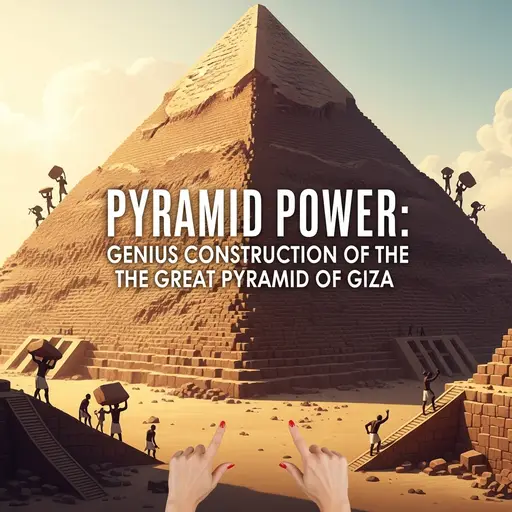
While the exact method of lifting blocks to extreme heights remains debated, the 'ramp theory' is prevalent. Scholars propose various ramp configurations, including a straight, external ramp, a spiraling ramp around the pyramid, or an internal ramp system. The precise design of these ramps would have been crucial for efficiently moving and placing the upper courses of stone, showcasing sophisticated architectural planning.
4. Internal Structure and Chambers
Beyond its external grandeur, the Great Pyramid boasts intricate internal passages and chambers, including the King's Chamber, Queen's Chamber, and the Grand Gallery. The construction of these spaces required advanced structural engineering to bear the immense weight of the overlying stones, utilizing carefully placed corbelled ceilings and granite beams to prevent collapse. The function and purpose of some of these internal spaces continue to intrigue researchers.
5. Mortar Mastery
Despite the immense weight and size of the stone blocks, they are fitted together with extraordinary precision, often with gaps so small that not even a blade can pass through. A gypsum-based mortar was used, acting less as a strong adhesive and more as a lubricant during construction, allowing blocks to slide into place. This mortar also served to fill any minor imperfections, ensuring a stable and cohesive structure.
6. Workforce and Organization
Contrary to popular myth, the pyramids were not built by slaves, but by a skilled and organized workforce of laborers, craftsmen, and overseers. Evidence suggests a well-fed and housed population, indicating a sophisticated system of resource management and labor organization. The sheer scale of the project demanded a highly efficient organizational structure, highlighting the administrative capabilities of ancient Egypt.
7. Water Management Systems
While not as widely discussed as the stone manipulation, evidence suggests that ancient Egyptians had sophisticated water management techniques that may have aided in construction. Some theories propose the use of water channels or canals to help move materials, or even as a part of precise leveling techniques for the foundation. Understanding water's role could unlock further secrets of their building prowess.