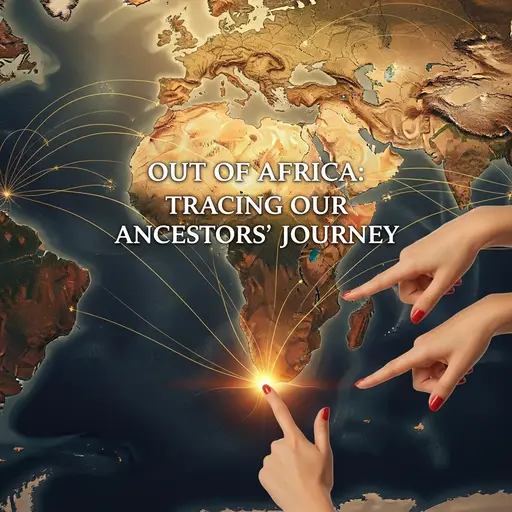
1. The 'Out of Africa' Model
The 'Out of Africa' Model posits that modern humans (Homo sapiens) originated in Africa roughly 200,000 to 300,000 years ago and then migrated outwards to colonize the rest of the world, replacing earlier hominin populations like Neanderthals and Homo erectus. This theory is strongly supported by fossil evidence exhibiting a clear progression towards modern human anatomy within Africa, coupled with extensive genetic studies that reveal the greatest human genetic diversity in African populations. These genetic markers act as molecular clocks, tracing ancestral lineages back to this African cradle, with subsequent migrations leading to reduced genetic variation in subsequent populations.
2. Early African Expansion Nodes
Evidence points to several key regions within Africa as likely origins for early human dispersal. Areas like the East African Rift Valley, with its rich fossil record (e.g., Omo Kibish fossils dated to ~195,000 years ago), and Southern Africa (e.g., Border Cave material suggesting early symbolism) highlight the continent's crucial role. These cradles of humanity likely fostered the early behavioral modernity and technological innovations necessary for survival and eventual migration across diverse environments.
3. The Southern Route Out
One of the earliest and most significant migration routes out of Africa likely followed the southern coast of the Arabian Peninsula. Archaeological sites in Yemen and the UAE, such as Jebel Faya, show early human presence dating back possibly over 100,000 years. This 'southern route' would have utilized coastal resources, taking advantage of potentially lower sea levels and more accessible land bridges during glacial periods, facilitating the initial steps of global colonization.
4. Southeast Asian Colonization
By approximately 50,000 to 60,000 years ago, early humans had reached Southeast Asia, islands like Flores (home of Homo floresiensis, though its exact relationship is debated) and eventually Australia. This monumental journey involved extensive seafaring, demonstrating sophisticated cognitive abilities and resourcefulness in navigating vast bodies of water. The rapid dispersal across this region showcases the adaptability of early Homo sapiens.
5. European Settlement and Adaptation
The migration into Europe occurred later, around 40,000 to 50,000 years ago, with humans encountering and interacting with Neanderthals. Sites like Bacho Kiro Cave in Bulgaria and Cro-Magnon finds in France provide crucial evidence of these early European settlers. These groups developed advanced stone tool technologies (e.g., Aurignacian culture) and early forms of art, adapting to the diverse and often challenging European landscapes.
6. Denisovan Encounters
Genetic evidence has revealed the existence of Denisovans, a sister group to Neanderthals, who also interbred with early Homo sapiens in Asia. Discoveries in Siberia's Denisova Cave provided the first physical remains. These interactions, documented through DNA analysis of modern populations in Melanesia and East Asia, highlight the complex genetic tapestry woven by ancient human migrations and interbreeding events.
7. Siberian and Beringian Crossing
The push into Northeast Asia and eventually across the Bering Land Bridge (Beringia) into the Americas occurred much later, likely around 15,000 to 20,000 years ago, though some studies suggest earlier migrations. This arduous journey across a glaciated landscape was a testament to human resilience. Archaeological sites like the Bluefish Caves in Yukon offer some of the earliest evidence of human presence in North America.