Banner or Pennant.
A victory banner is symbol of victory over pride, greed, fear and unpleasant feelings.
A Makara banner, contains a fish like creature and in Buddhism symbolizes victory of Buddha over Mara (delusion), or victory of knowledge over ignorance.
Battle axe.
This ceremonial weaponry was used in tantric rituals to combat obstacles to enlightenment, such as ignorance, delusions, and selfishness.
Bell or dril-bu.
The bell represents wisdom.
Combined together with a vajra they symbolize enlightenment as they embody the union of all dualities i.e. bliss and emptiness, compassion and wisdom, appearance and reality, conventional truth and ultimate truth, and male and female.
The bell also signifies never forsaking sentient beings, taking sentient beings into their care and equanimity and working together with sentient beings along with wisdom and empathy.
The sound of the bell is symbolic of the voice of Buddha and his teachings.
Bone ornaments.
Bone ornaments are symbolic ornamentation worn by certain yidam deities. Depending on the particular sadhana, for example with the five peaceful deity, a bone ring at the top of her head, that symbolizes the wisdom of the basic space of phenomena, a bone necklace, that symbolizes the wisdom of equality, bone earrings that symbolizes discerning wisdom, bone bracelets, that symbolizes mirror-like wisdom and a bone belt that symbolizes all-accomplishing wisdom.
Bow and Arrow
The Bow represents Action and the skilful means to propel; The Arrow represents Intelligence, sharp and penetrating. Together they represent skilful intelligence.
Bracelets.
Bracelets symbolize the paramita or perfection of patience and the wisdom of suchness and the conquering of the five poisons.
Chain.
Used by gatekeepers of mandala for example to pull in people who have stayed from the path. The chain signifies never forsaking sentient beings, taking sentient beings into their care and also overwhelming the mara of the destructive emotions or empathetic joy and benefiting action.
Club
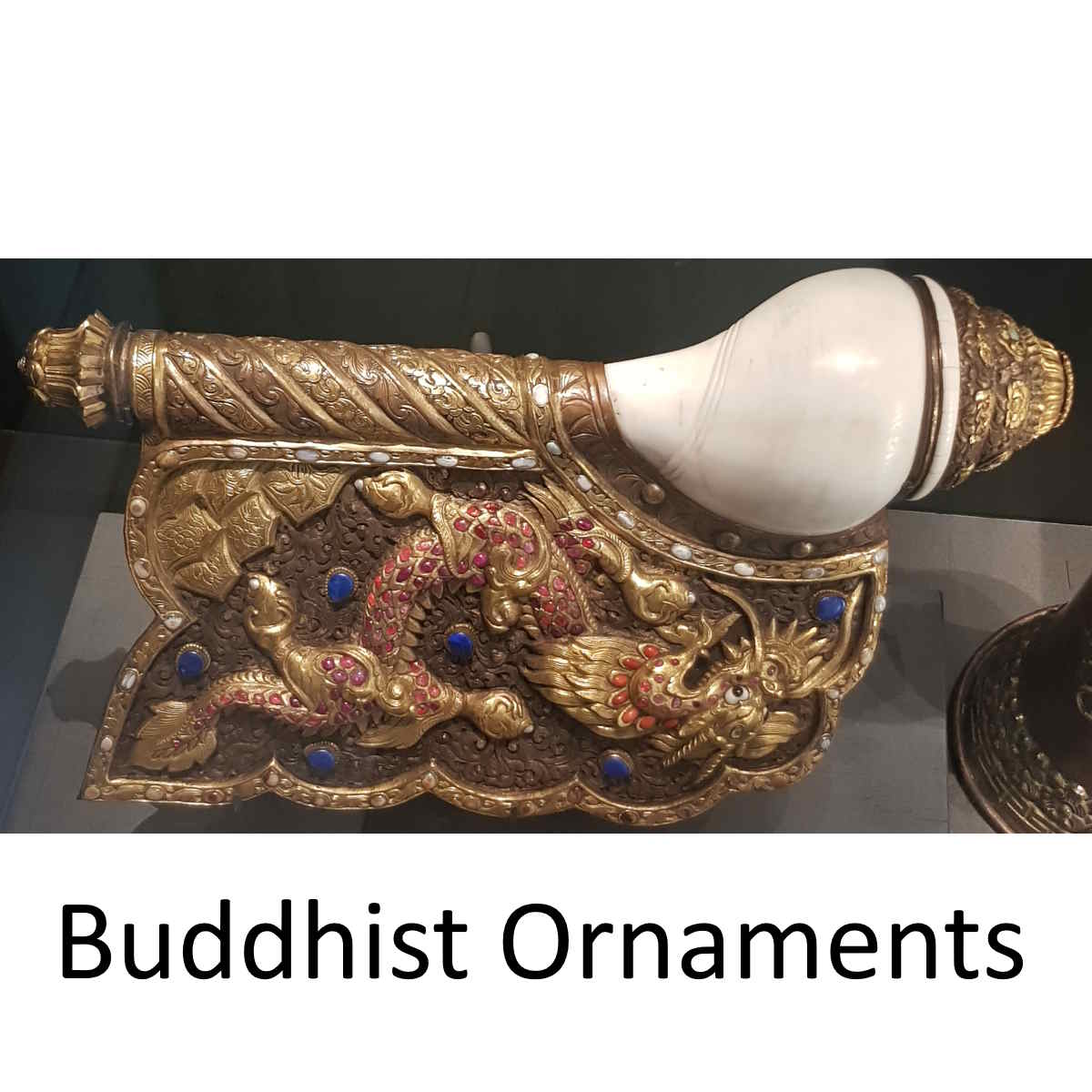
Conch.
A conch shell is the symbol of the sound of Dharma awakening beings to their Buddha nature and is symbolic of the fearlessness of teaching the truth of working purely for the benefit of others. It also represents spreading the beliefs of Buddha which would spread in every direction just like the sound of the horn through the shell.
It is normally placed in a vertical position and has a silk ribbon around it.
Curved knife, Hooked Knife, Shaving Knife or Vajra Chopper.
The curved knife or kartrika, drigug or flaying knife, symbolizes the power to sever the obstacles of delusions, karmic negativity and intellectual defects such as pride and envy from practitioners with the sharp edge of wisdom. The ritual knife is invariably paired with the skullcup (kapala) as a metaphor of the Tantric methodology the inseparable union of skilful means and wisdom, it symbolizes enriching, extending your influence over others to assist with the shredding of all materialistic, negative attitudes held within the skull vessel of the understanding of voidness.
In summary it is a symbolic implement for the destruction of the ego that is deeply rooted within us.
Dagger, Peg, Kila, Pointed Stake or Phurba
The three edges represent the three spheres, the handle being the world axis which unities the three it has the ability of wisdom to nail down and thus subjugate demons. It is the sharp point of wisdom fixed immobile onto goodness by the power of one-pointed concentration.
The phurba is also used as a ritual implement to signify stability on a prayer ground during ceremonies, and only those initiated in its use, or otherwise empowered, are meant to wield it. The energy of the phurba is fierce, wrathful, piercing, affixing, transfixing and it affixes the elemental process of space to the Earth, thereby establishing an energetic continuum.
Demons underfoot.
Represents the paralysis of ego.
Discus or cakra.
The discus (cakra) represents universal mind.
Drum.
A drum that is kept to the right of an altar inside a shrine is used during chanting. Its sound symbolises the end of the cycle of rebirth which inevitably leads to happiness.
A damaru drum is used in Chod practice. According to this practice, the sound of the chod drum proclaims impermanence and symbolizes the cutting through of egotism. Chod practitioners use the drum to summon dakas and dakinis to the dance of ego and annihilation and to summon spirits to the great feast. The dual bowl shaped drum has glued drum heads and is usually held in the right hand. It is played by twisting the wrist to activate a striker on each side.
Ear ornament.
For patience.
Earlobes.
The large earlobes symbolize wisdom.
Earrings
Represent the wisdom of investigative or discriminating awareness.
Elephant goad or hook.
Used by gatekeepers of the mandala for example to pull in people who have left the path. The hook signifies never forsaking sentient beings, taking sentient beings into their care.
Elephant-hide or elephant skin clothing.
The flayed skin of an elephant, represents victory over narrow-mindedness, the ten powers of a buddha and the purity of ignorance without its obliteration or the destruction of ignorance with the ten powers.
The elephant’s skin draped over the upper part of the body symbolizes the subjugation or overcoming of ones ego and delusion. This goes back to the jataka tales of Buddha where the Buddha tames the drunk and enraged elephant with his compassion and kindness. Elephant therefore symbolizes the ego.
Fangs
These fangs grind up the false world appearing to materialistic perceptions.
Flames and fire or a heap of fire.
Representing the tremendous unceasing energy of anger without hatred, the energy of compassion.
Fire also represents the realization of emptiness to destroy cyclic existence in the three realms and burn afflictions and suffering of sentient beings in the six realms with realization of emptiness.
Fly whisk or camara.
A fly-whisk or fly-swish is a tool that is used to swat flies. A similar gadget is used as a hand fan in hot tropical climates, sometimes as part of regalia, and is called a chowrie, chāmara, or prakirnaka in South Asia and Tibet.
The fly-whisk in Buddhism represents the symbolic "sweeping" of ignorance and mental afflictions.
Garland or necklace of heads.
Sometimes the fierce deities wear these as trophies of their slain enemies, they signify conquered passions and obstructive mentalities: lust, pretense, aggression, spite, hypocrisy, etc. Wisdom turns these severed negative attitudes into ornaments.
Girdle or belt.
Girdles symbolize the paramita or perfection of morality and the wisdom of accomplishing activities or action.
Golden Fish.
Often depicted as two golden fish standing with their heads facing each other. A symbol of happiness and freedom, abundance and fertility.
Human Corpse
Promotes the idea of human impermanence, the decaying corpse used for contemplation and reflection on the transient nature of human life.
Human-skin clothing.
The human skin (mi lpags gyang zhi) draped over the shoulders a deity symbolizes impermanence, or the practitioners triumph over the attachment. The reason why it is human skin is that the first attachment we have is to our own body, for that reason a metaphoric human skin is worn by the deity.
Jewellery.
e.g. with a necklace it can be associated with a goddess calling upon Buddha for succor, each bead of it representing all living beings and the turning of the beads symbolizes the goddess leading them out of their state of misery and repeated rounds of rebirth into nirvana, hence the beads represent enlightenment.
Khatvanga / Skull Topped Trident.
A divine attribute of Padmasambhava and endemic to his iconographic representation and depicted as an accoutrement of his divine consorts, Mandarava and Yeshe Tsogyal. In the twilight language, it represents Yab-Yum. The three severed heads attached denotes moksha from the three worlds (Trailokya), it has sometimes has a rainbow sash representing the Five Pure Lights of the mahābhūta.
Knot or endless knot.
A symbol of peace and harmony or our interconnectedness, depicting that everything is connected to each other and that nothing is separated.
Lotus.
In Buddhism the lotus, or padma, is a symbol of enlightenment and the the purity of Nirvana.
The lotus flower grows and blossoms into the most beautiful of flowers despite arising from dirty waters and can be seen as the human condition, which awakens through the suffering of Samsara and can be seen to represent mind, body, and speech.
The lotus is also often associated with wisdom.
Nakedness.
Not wearing anything else signifies the unobstructed tathāgatagarbha or the nature of mind.
Necklace.
For diligence and representing the wisdom of sameness or equality.
Noose of Human Intestines.
Intestines represent practices of the Illusory Body, described often as Father Tantra.
Noose or Lasso or Vajra Lasso.
Used by gatekeepers of mandala for example to pull in people who have strayed from the path. The noose signifies never forsaking sentient beings, taking sentient beings into their care and also compassion and kind words, it can also binds demons, and bind beings to wisdom from life to life.
Offering scarf.
For knowledge.
Parasol or Umbrella.
A symbol of protection from harm and illness.
A peacock umbrella where represented is the traditional symbol of protection)
Pearls
The pearl ( often portrayed as a ball with a pointy top) is a representation of spiritual knowledge and wealth. With its radiance, it brings with it the teachings of the Buddha. It symbolizes the values of empathy and wisdom, which are two of the most sought-after attributes.
Rhino Hide Armour
Represents power.
Short Spear or Three Pronged Spear.
A short spear pierces through perverted views or ignorance, a three-pronged spear symbolizes destruction (with one thrust of this spear you make three wounds, the ultimate destruction of ignorance, passion, and aggression simultaneously.
Skull crown or crown.
For contemplation, regarding the negativities or emotions which are not destroyed or abandoned or condemned for being bad but are understood and worn.
When worn by a wrathful deity it has a threefold meaning, first, like the five-Buddha crown on the head of peaceful deities, they signify the Five Tathagatas; second, they signify the purity of the five poisons without
obliterating them, third, they represent the five wisdoms of the Five Tathagatas, i.e. they represent the five main afflictions, anger, greed, pride, envy and ignorance, conquered and transmuted into the five wisdoms; ultimate reality, discriminating, equalizing, all accomplishing, and mirror like wisdoms.
Skull cup or skull bowl.
A skull cup or kapala is a symbol of wisdom (prajna) and knowledge.
In Tibetan monasteries a kapala is used symbolically to hold bread or dough cakes, torma, and wine instead of blood and flesh as offerings to wrathful deities, such as the ferocious Dharmapāla.
In the inner-level or subtle-body practices of Buddhist Tantra, the underside of the skull contains the moon drops, which are melted by tummo or inner heat yoga, creating a cooling sensation of bliss as the drops move through the inner channels.
In depictions might might be seen as holding amrita the intoxicating nectar of the gods which is a means of pacification.
In summary it contains the essential elixir of insight into voidness, when full of blood, it represents the purification of egotism.
Snake.
The heart of all the problems, frustrations and disappointment we experience are just three things, hatred, desire and ignorance. In traditional Buddhist teachings, these states of mind are represented by a snake, a rooster and a pig.
Staff, Baton or Ddanda or Khatvanga.
The Ritual Staff or Khatvanga, is mostly used in the Tantric context, Khatvanga is a staff with a skull or more on top and in the Indic sphere, it is shown in the hands of the earliest known Tantric images. It consists of a short staff, surmounted by a skull or skulls from the top of which a vajra emerges.
Three heads or skulls where displayed on the tip of the khatvanga or adept's Staff are sometimes represented in varying stages of decay, one freshly severed head, one shrunken head, and one skull when so, they symbolize the conquest of the three poisons of desire, hate and ignorance, respectively or when with a dakini they may be the symbol of the hidden
consort, skilful means and compassion.
These may for example in Chinese Buddhism be Ruyi or sceptres which were used as a baton held by a speaker in a conversation, a talking stick, or symbol of authority and later became imbued with different Buddhist meanings.
Sword or Vajra Sword.
In Buddhism the sword is seen as a tool for gathering energies together and is associated with wisdom, the sword symbolizes the 8 Mahasiddhas (Mahasiddhas embody and cultivates the siddhi of perfection) and the cutting through of ignorance with discerning wisdom.
Three colored balls.
These symbolize the three jewels or three refuges of the Buddhist, the Buddha, the Dharma (the law), and the Sangha (the Buddhist or monastic community).
Three Eyes or Third Eye.
Seen on tantric deities it symbolize seeing the the past, the present, and the future and direct vision of the unity of ultimate reality. It exists simultaneously with the two usual eyes, which see the dualistic, relative world of human beings.
Three eyes are comprising a pair of eyes, a dot between the eyes, and a curly shape are also a symbol that the Buddha is always watching and his presence is not limited, the two eyes representing the potential to see reality or the outside world, and the the dot or third eye symbolic of Buddha’s awakening.
The curly line depicts unity and the connectedness of everything and also highlights that the only path to enlightenment is through the teachings of Buddha.
Tiger-skin cassock.
To over come the anger, skin of the tiger is depicted. As a whole it symbolizes the over coming of the three poisons which is similar to the depiction of pig, snake, and roster in the center of the Buddhist wheel of existences or life (Bhavacakra), it can also represent the transformation of anger into wisdom and insight or the purity of aversion without its obliteration.
Top Knot or bun.
A top knot or Ushnisha represents a crown and refers to his liberation.
Treasure vase or urn.
A treasure vase is the symbol of the bountiful treasure of the Buddha’s teachings, no matter how many teachings he shared, the treasure never lessened.
Vajra, Dorje, Club, Battle Club (scepter/sceptre).
The vajra represents method, and symbolizes the five primordial wisdoms.
Combined together with a bell they symbolize enlightenment as they embody the union of all dualities i.e. bliss and emptiness, compassion and wisdom, appearance and reality, conventional truth and ultimate truth, and male and female.
The vajra represents also the four noble truths and it works like a diamond as it has the power to overcome attachment, ignorance, and self-loathing.
A double, visvavajara, viswavajra or cross Vajra also exists, the double vajra (Skt. vishva-vajra; Tib. རྡོ་རྗེ་རྒྱ་གྲམ་, dorje gyadram is formed from four lotus-mounted vajra-heads that emanate from a central hub towards the four cardinal directions, and symbolizes the principle of absolute stability which is the union of wisdom and compassion.
Vase.
The vase of the elixir of immortality shows that enlightenment results in boundless life. It is sometimes held by Maitreya, sometimes by Avalokiteshvara.
Wheel or Dharma Wheel.
The dharma wheel or dharmachakra is a symbol of the Buddha teaching the Dharma.
It is usually made of eight spokes which are symbolic of eightfold path and three swirls at the center which symbolize the three jewels of Buddhism.
Wooden pestle.
The vajra pestle (kongōsho) has long been used in Esoteric Buddhist rituals. The word vajra means diamond and thunderbolt in Sanskrit. Vajras and the like are thus indestructible and powerful tools of Buddhism.
Wooden stick with a vajra on top.
Symbolizes overwhelming the mara of the sons of the gods.
Wooden stick with double vajra on top.
Symbolizes overwhelming the mara of the aggregates.
Wooden stick with mans head on top.
Symbolizes overwhelming the lord of death.